
Attention, Retention, and the Price of a Click: How ASEAN Enterprises Are Rewriting Customer Growth

Attention, Retention, and the Price of a Click: How ASEAN Enterprises Are Rewriting Customer Growth
TLDR;
Growth is shifting from acquisition funnels to embedded, lifecycle-based customer engagement
Banks and telcos are moving from fragmented data to actionable “customer 360” in real time
Attention is collapsing into seconds, decisions are made in micro-moments, not long journeys
AI is becoming an invisible layer that determines visibility, not just efficiency
The new competitive edge is not owning the customer journey but being present inside it
In a mall, what makes you stop mid-step?
Mid-scroll, what makes you pause and click?
What turns a one-time purchase into a return visit, or a simple interaction into a 5-star review?
In a world of rising acquisition costs and constant competition, the real challenge is simple: how do you capture attention and keep it?
ASEAN enterprises are measuring innovation through operational efficiency (84.3%), cost savings (78.3%), and customer satisfaction (71.1%), according to the 2025/26 AIBP Enterprise Innovation Survey.
Against this backdrop, AIBP, together with Adobe, brought Malaysian enterprise leaders together in Kuala Lumpur to unpack how customer growth is actually playing out on the ground.
The shift from customer view to customer journey
For many institutions, the first act of transformation has been structural rather than technological.
A recurring theme was the move from fragmented “single customer views” to more integrated “customer 360” models. But the real shift is in intent.

Siew Kum Weng, Head of Data Transformation from Bank Islam described the problem in practical terms: customers no longer stay within a single financial lifecycle. For the banks, this creates a structural challenge around continuity, ensuring customers don’t exit at one life stage only to reappear with another institution at the next. What this exposes is a deeper gap in how banks design for the customer journey.
It shifts the lens of transformation away from product-centric thinking toward lifecycle design: mapping financial needs across life stages, and more critically, identifying where institutions fail to stay relevant at key transition points.
Experience as infrastructure
At the customer experience layer, the conversation becomes more immediate and more operational.

At RHB Bank, Michelle Liew, Head of Group Customer Experience from RHB Bank described the goal as making data visible and usable at every touchpoint, not just at the analytics layer.
With millions of feedback points collected annually, the opportunity is how to translate sentiment into frontline action and how to ensure that what customers say becomes visible and usable by the people serving them in real time.
As she noted, the goal is to make data usable at every touchpoint, so frontline teams and agents can understand not just past interactions, but the potential future experience they can deliver.

Elsewhere, in the telecommunications space, the problem is different but structurally similar. At CelcomDigi, Joon Haow Book, Head of CX Transformation Product Segments shared that their agents reportedly navigate more than 40 backend systems to resolve a single customer issue. AI is being introduced as a consolidation layer surfacing relevant billing or network information to reduce handling time and improve first-contact resolution.
Before customer churn, he shared, transaction-based feedback loops such as post-interaction satisfaction tracking are already being used to guide service improvements and trigger customer follow-ups where needed.
The economics of attention
Attention doesn’t drift. It collapses.
Growth, in this context, is no longer about guiding customers down a funnel. It’s about winning the moment when attention briefly surfaces.

Annas Muazzam, Head of Payments Product Management & Acquisition at Hong Leong Bank, described how customer decisions often occur in “two-second windows”: brief moments at physical or digital points of sale where attention, not rational evaluation, drives product choice.
Within that window, three signals dominate: cashback value, perceived rewards utility, and simplicity (“no annual fee” remains one of the most powerful triggers in the market).
This reframes growth not as a long-term funnel, but as a micro-interaction problem: how to compress value into instantly legible signals.
A parallel shift is playing out in physical environments.

Serena Nguyen, Strategic Account Executive from Adobe, pointed to Changi Airport, long considered a benchmark for experience as a case in point. Even here, passenger spending patterns have shifted post-pandemic, shaped by e-commerce alternatives, currency movements, and changing travel behaviour.
The emerging focus is loyalty as a sustained engagement system that connects identity, behaviour, and reward across journeys. Because when attention is fleeting, retention is how well those moments connect.
The emerging pattern: visibility is the new growth layer
The most consequential shift discussed was not in customer experience design but in where the customer relationship now begins.
A strong illustration came from the SME transformation work at Maybank through its Bank Feed initiative, last year's AIBP Innovation Awards (Open Category) Winner, 2025.
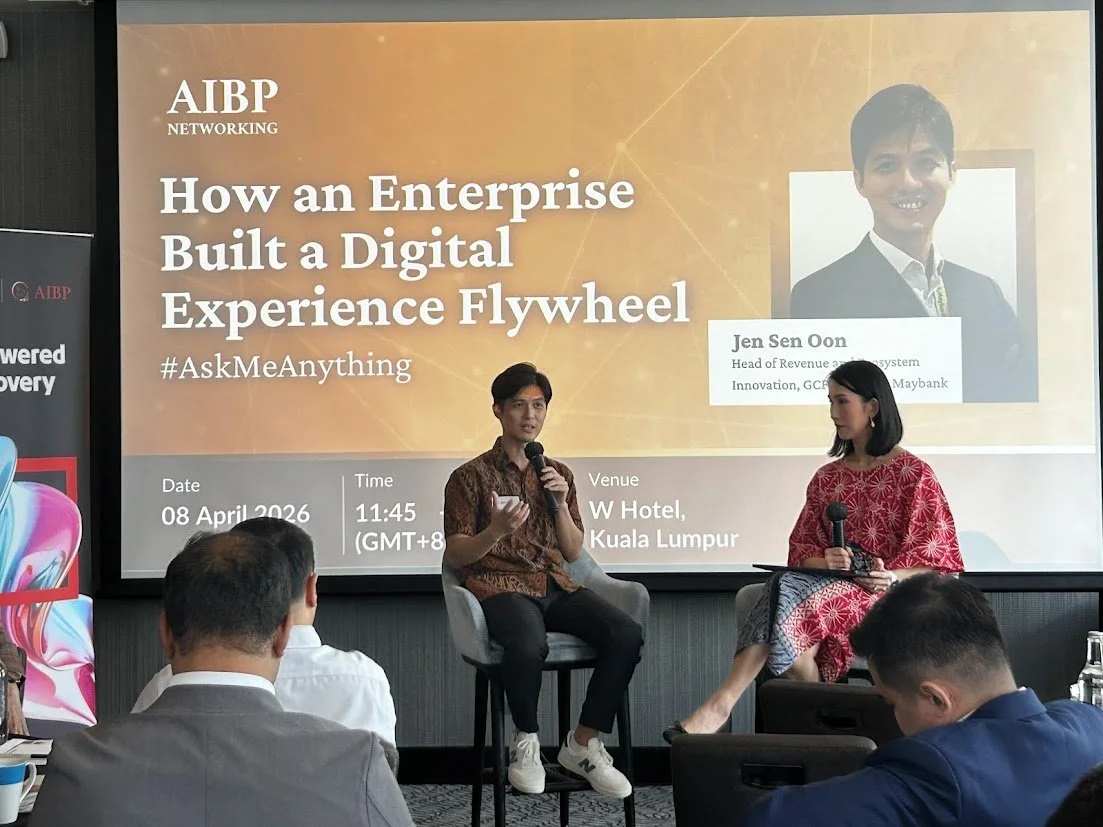
Jen Sen Oon, Head of Revenue and Ecosystem Innovation, GCFS Strategy explained that instead of asking customers to log into banking systems, Maybank began integrating with external platforms so that financial actions, reconciliation, payroll, supplier payments, could happen inside the tools SMEs already use daily.
The effect was twofold: Maybank gained access to richer transactional and behavioural signals, and customers gained convenience without friction.
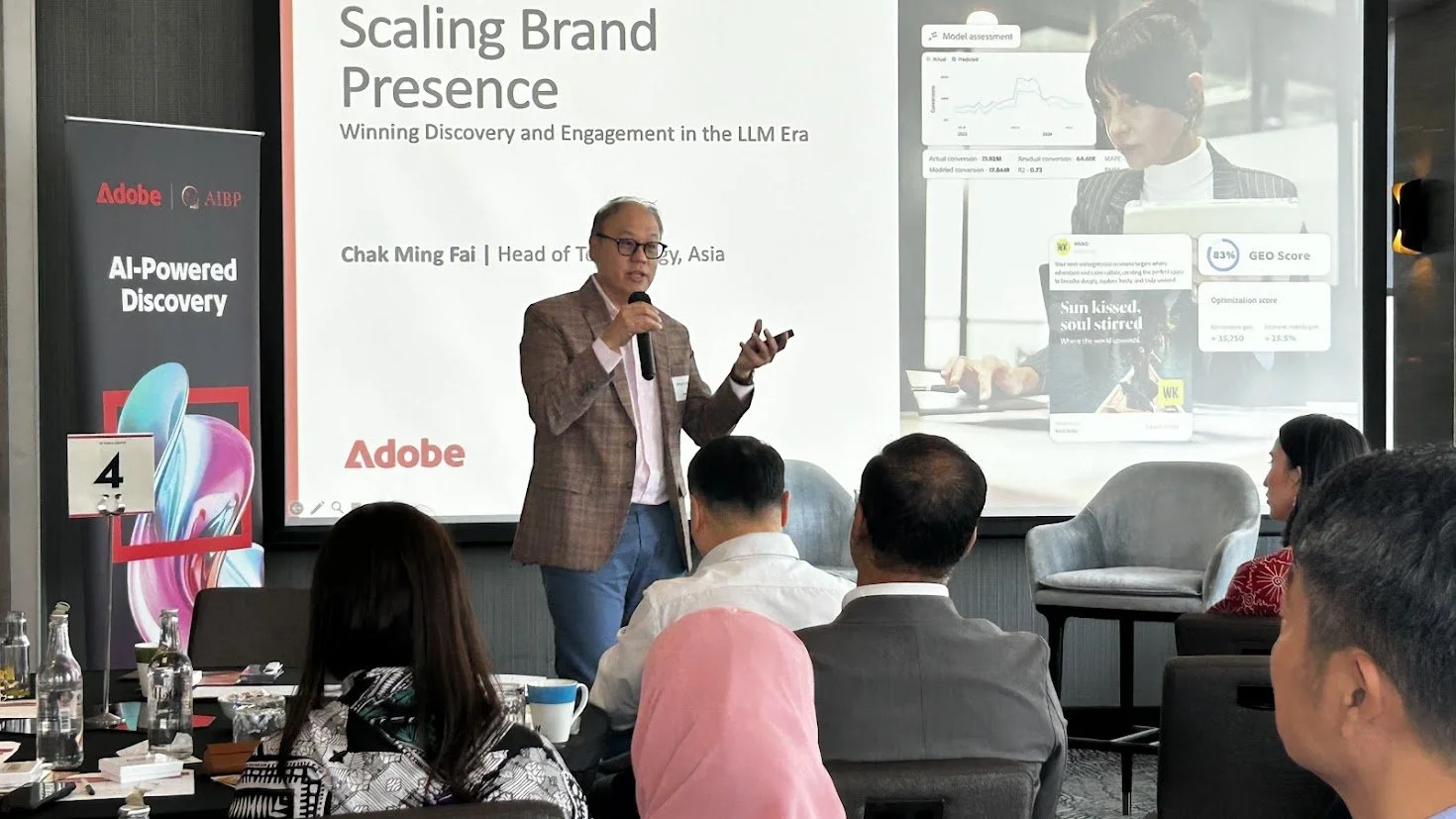
Ming Fai Chak, Head of Technology for Adobe South-East Asia, framed the problem at a broader digital experience level: brands are increasingly being interpreted not on their own platforms, but through AI-mediated environments: search engines, chatbots, and generative interfaces.
The parallel to Maybank’s Bank Feed is striking where value is no longer created at the point of direct interaction, but at the point of embedded presence whether inside SME workflows or AI-generated answers.
Chak’s point was that most enterprises still design content and services for human interfaces, while discovery is increasingly mediated by AI systems.
Bank Feed increases visibility by embedding financial services directly into the customer’s operational ecosystem. In this case, visibility is no longer passive.. It is about being correctly surfaced, inside the systems that now mediate customer decisions.
Growth is now a question of where you exist
For decades, growth was anchored in acquisition bringing customers into controlled environments, whether branches, websites, or apps. The assumption was that value was created inside those environments.
Today, customers encounter institutions earlier, more frequently, and more indirectly through embedded financial services, AI-generated summaries, and platform-mediated interactions.
In this environment, the decisive question is no longer how many customers you have, but where you are visible when decisions are being made.
Between those two sits a new competitive frontier: not attention in isolation, but access to the moments where attention is formed.
And in that sense, growth is a question of presence: inside systems, inside workflows, and increasingly, inside the invisible layer where decisions are quietly made.
How do you design an experience that doesn’t just attract customers, but stays with them long after?
We’re gathering real-world case studies on Customer Growth exploring acquisition, engagement, and lifetime value in today’s competitive landscape.
If this is your space, we’d love to hear from you. Register your interest to join the survey and help shape the agenda for our 52nd Conference & Exhibition.
Curious how other enterprises across ASEAN are approaching customer acquisition and retention? As a bonus, you’ll also get access to our CX report featuring case
