
AIBP Conference & Exhibition Thailand 2026 Day 1: Governance as the Guardrail for Curiosity
According to the National Board of Digital Economy and Society Office (BDE), Thailand's digital economy is forecast to hit THB 5.7 trillion this year, growing at more than twice the pace of the wider economy.
The AIBP Conference & Exhibition Thailand 2026 opened on 2 September at W Hotel Bangkok, against this promising backdrop.
Asst. Prof. Dr. Polawat Witoolkollachit, Inspector General at the Ministry of Digital Economy and Society, pointed to Thai Lom, an open-source AI model built specifically for the Thai language.

The model gives Thai developers a foundation built for their own language and context, lowering the barrier to build real products on top of it.
Across the day, senior leaders from Thailand's largest enterprises and public institutions ran into these questions:
Who answers for an AI recommendation once it reaches a patient or customer?
Who owns the AI tools employees already use on their own?
Who's accountable for the AI risk hiding inside a vendor's own supply chain?
Every conversation traced back to the same thread: accountability has to move as fast as the AI decisions it's meant to govern.
Speed Demands Ownership
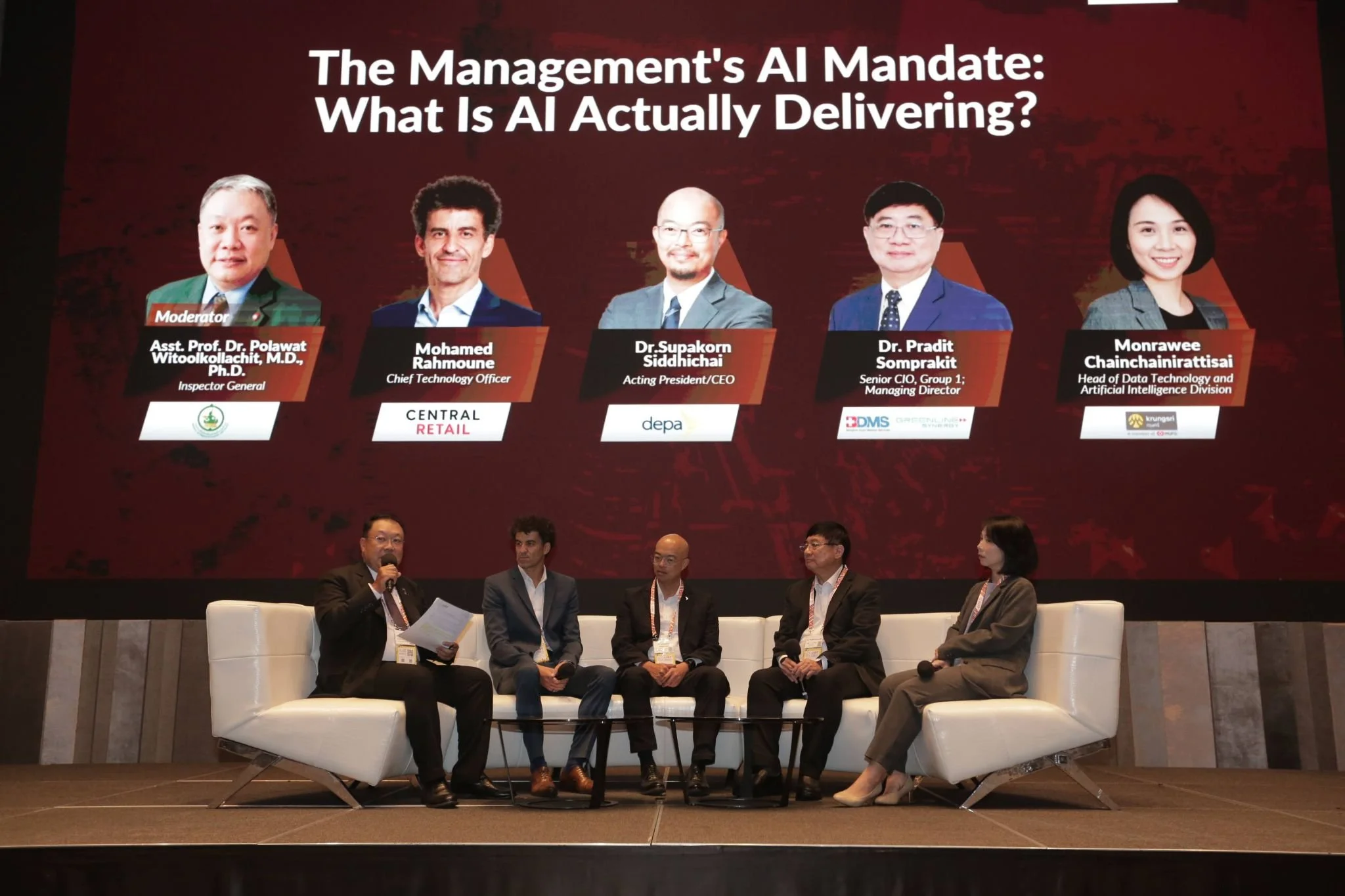
For Thai enterprise, the question has shifted from "are you adopting AI?" to "what value are you actually getting from AI?,". Dr. Supakorn Siddhichai, Acting President/CEO at DEPA, highlighted the distinction clearly on whether the time AI saves gets redeployed productively, or simply absorbed.
He framed AI governance as a business decision owned by the whole organisation, not a technical or IT-only matter: leaders need to treat it as business transformation, not technical transformation.
Organisations evolve on a steady curve, while the technology they're adopting moves on an exponential one. Mohamed Rahmoune, Chief Technology Officer at Central Retail, highlighted this disparity as the reason his team under-promises deliberately, giving trust time to build while capability keeps its distance ahead.
At BDMS, the same tension runs sharper because the stakes are clinical. Dr. Pradit Somprakit, Senior CIO, explained that AI in healthcare does not follow the conventional multi-year drug-approval testing cycle, because the models themselves keep changing.
Trust comes instead from keeping the clinician in the loop and accountable for outcomes, not the algorithm. AI's role is to free up time for more human interaction with patients, not to replace clinical judgement.
Krungsri’s approach to fraud detection is now measured in seconds. Monrawee Chainchainirattisai, Head of Data Technology and AI, described a shift from catching mule accounts after money has already moved to real-time behavioural and biometric verification, intercepting fraud before the loss happens. A dedicated fraud team adapts continuously as scam tactics evolve, treating trust as the bank's core currency with customers.
Across every industry, responsibility landed on a person, however fast the technology underneath kept changing.
Adoption Outpaces the Policy

For Hafiz Badrie Lubis, Director of Data and AI at Bumrungrad International Hospital, adoption and governance move together. The two only work when both are tied to a clear business value that the AI is meant to deliver.
At AXONS, part of CPF's IT arm, that value shows up as a cross-functional committee. Teerapong Wichayaruangrom, Director of Strategy and Digital Transformation, built it after employees started asking for AI before the data underneath it was even clean or authorised for use. The committee sets guardrails and expectations upfront, rather than reviewing every request one by one.
King Power runs the same idea as a formal structure. Dr. Lisa Patvivatsiri, Chief Digital Officer, keeps the platform centralised, so the business unit that owns a use case also owns its outcome, and accountability stays with a person rather than the tool.
"Good governance should not kill curiosity," she said. "It should give it a safe place to go, with the right guardrails."
Gary Liu of Terminal 3 put it in plainer terms, comparing AI to caffeine. Ban it outright and most employees lose something that helps them work better. Force everyone onto one approved version and it stops working for people it doesn't suit. His answer: let people use AI freely for everyday thinking, but route the decisions that really matter to a person working without it.
Funding is what turns any of this into something that lasts, according to Chawana Huangsuntornchai, Privacy Team Lead at LINE. Governance holds up when the business pays for it and drives it from the top, rather than leaving each employee to figure out the rules on their own.
The reality is, technology will always outpace policy. What lasts is building guardrails that actually add business value, and making sure there’s still a real person owning the final result.
Trust Requires Continuous Verification
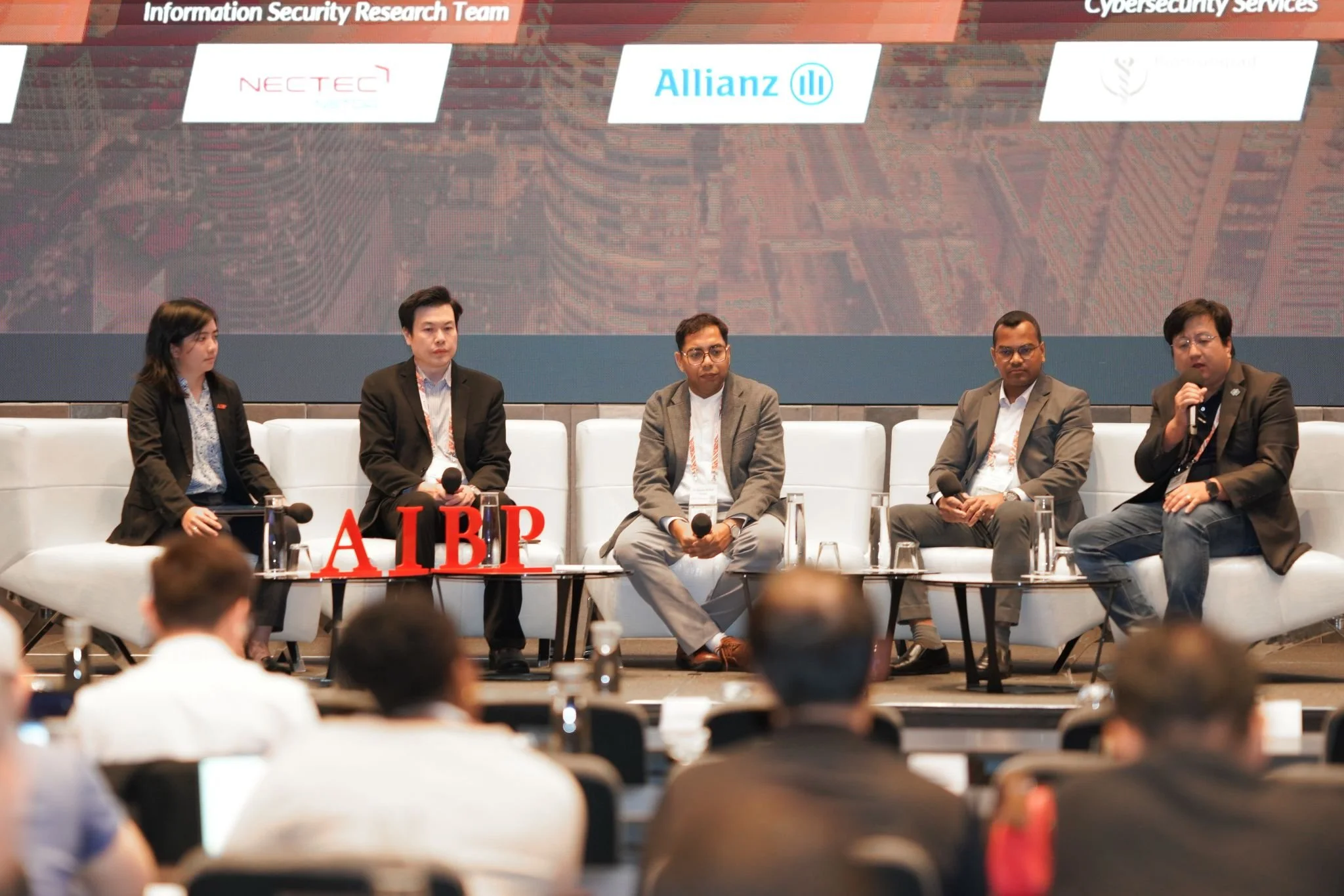
Once AI runs on infrastructure outside a company's own walls, the accountability question from earlier in the day gets harder to answer..
For Manoj Kumar Murmu, Senior Director of Cybersecurity at Bumrungrad International Hospital, a vendor's AI failure lands somewhere most technology failures never reach: the patient, directly. That stake is what pulls his team into vendor deals early, working as a design partner from the start rather than signing off at the end.
Verifying the AI itself is the harder problem underneath that. An AI's answer resists the kind of easy check a calculator's answer allows. Dr Chalee Vorakulpipat of NECTEC argues the fix isn't checking the output at all, it's seeing the data feeding the model clearly enough to trust it, backed by ongoing monitoring and privacy safeguards under PDPA.
That risk grows once you trace where the data actually travels. Dr Gaurav Kumar Gupta of Allianz Technology maps a single application running through a model provider, a vector database and cloud infrastructure hidden past the first layer, arguing that owning the outcome means owning every layer feeding into it, regardless of which vendor built which piece.
At Bumrungrad, that ownership currently splits across procurement, security, data and legal, each holding a slice while the full picture still waits for a single owner to claim it.
Bitkub's Chief Security Officer, Mongkol Chutpathumthong, sees the problem from the inside out. For him, shadow AI is already running quietly across most organisations. It is less of a future threat and more of a risk hiding in plain sight until someone decides to look.
His standard for the room was clear: "Trust, but verify, continuously," a reminder that a vendor's reputation means less than the ongoing check behind it, since the model powering that name keeps shifting underneath.
Visibility, across every layer and every vendor, was the real safeguard
Where Day One Left It

What surfaced across Day One was accountability, turned inward. Every discussion boiled down to the same core tension: how far an organisation trusts its own people to use AI well, and who it holds responsible when that trust gets tested.
Guardrails give curiosity room to flourish inside an organisation, rather than holding it back.
Day Two shifted the focus to the practical applications of AI: showing how it directly impacts customer experience, streamlines supply chains, and forces a critical strategic choice: building custom technology or buying ready-made tools.
About ASEAN Innovation Business Platform (AIBP)
The ASEAN Innovation Business Platform (AIBP) is an initiative focused on enabling innovation and strategic partnerships across public and private organisations in Southeast Asia. Through curated engagement activities, AIBP supports the growth of regional government agencies, enterprises and solution providers in navigating key themes such as innovation, digital transformation, and sustainability.
Learn more at www.aibp.sg
