
Efficiency Under Pressure: Why ASEAN Enterprises Are Rethinking the Supply Chain
Enterprises across Southeast Asia are operating under growing pressure to deliver measurable operational outcomes. Cost volatility, supply chain disruption and rising sustainability expectations are forcing organisations to rethink how decisions are made across increasingly complex operating environments.
According to AIBP’s 2025/2026 ASEAN Enterprise Innovation Market Overview, 80.2% of enterprises prioritise cost optimisation and operational efficiency when investing in digital transformation initiatives.
Yet achieving efficiency at scale is proving more difficult than anticipated. Many organisations have invested heavily in automation, analytics and digital platforms over the past decade, but fragmented systems, legacy processes and organisational silos continue to limit the value those investments deliver. The challenge facing enterprises today is not simply how to adopt new technologies, but how to integrate them across the end-to-end supply chain while maintaining resilience and governance.
Sustainability Is Becoming Embedded in Supply Chain Decisions
As enterprises work to optimise supply chain performance across increasingly complex networks, operational decisions are being shaped by a broader set of strategic pressures. Beyond cost and efficiency, organisations must now account for rising expectations around environmental accountability, regulatory compliance and long-term resilience.
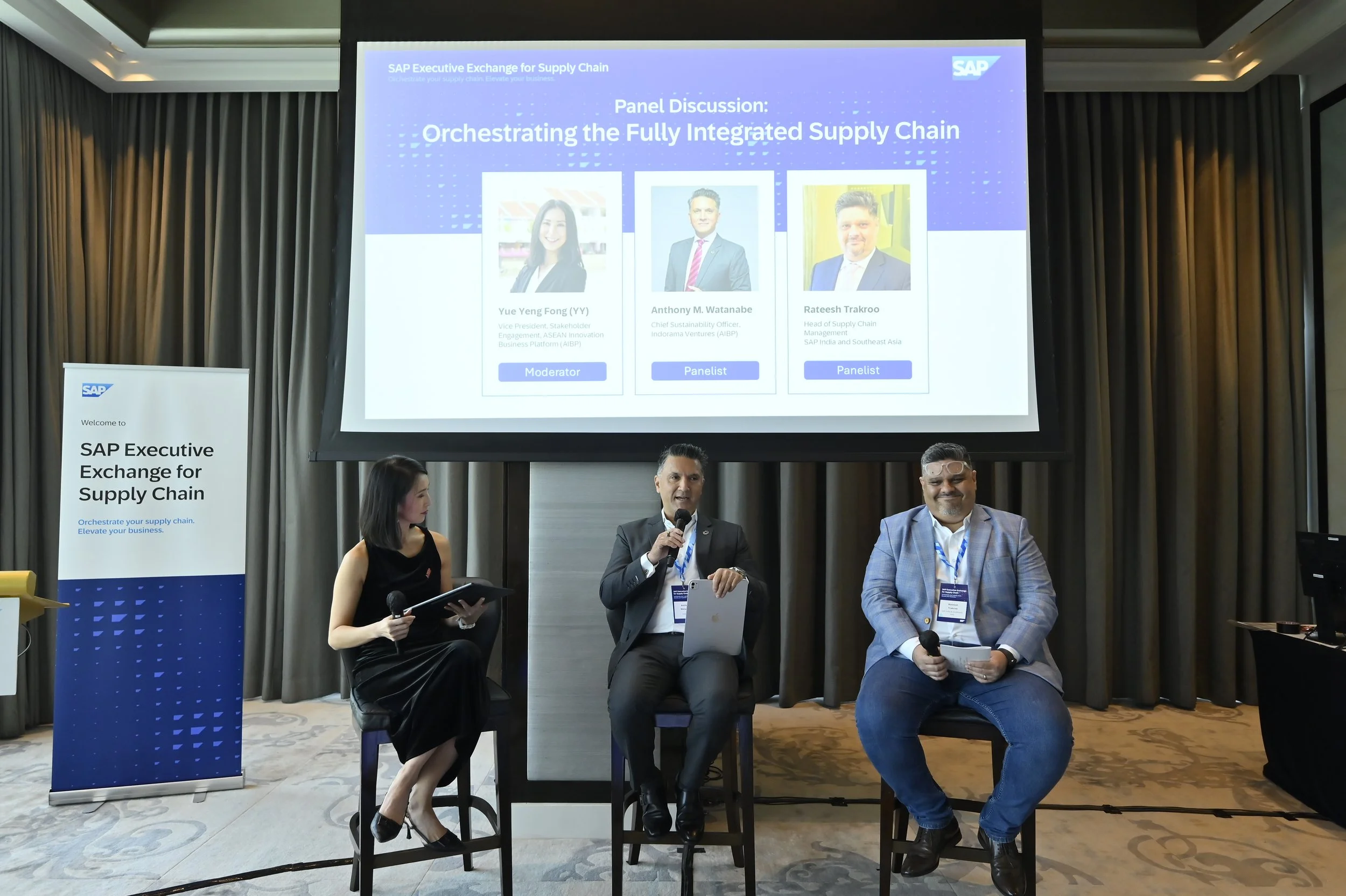
Anthony M. Watanabe, Chief Sustainability Officer at Indorama Ventures, noted that sustainability initiatives are now closely tied to operational strategy. From his perspective, sustainability contributes to both value protection and value creation: protecting businesses against resource volatility and regulatory change while also enabling new products and financing opportunities.
However, integrating sustainability into supply chain management introduces significant operational complexity. Watanabe observed that more than 80% of Indorama Ventures’ total emissions fall under Scope 3, largely linked to raw materials and activities across the supply chain. This means that even well-managed internal operations cannot achieve sustainability targets without coordination across suppliers, logistics partners and production networks.
For many enterprises, sustainability is therefore no longer a separate initiative but an additional dimension shaping how supply chains are managed.
The Trade-off Between Efficiency and Complexity
Supply chains have always required coordination, but the level of complexity facing enterprises today has intensified. Global production networks are more geographically dispersed, regulatory expectations around sustainability and reporting are expanding, and geopolitical tensions are introducing new forms of disruption.
This environment creates a difficult trade-off. Organisations must pursue efficiency to remain competitive, yet the very scale and fragmentation of modern supply chains makes coordination more challenging. Decisions made in procurement, production or logistics rarely affect only one function; they ripple across finance, customer fulfilment and regulatory compliance.
Rateesh Trakroo, Head of Supply Chain Management for SAP India and Southeast Asia, described this dynamic during the discussion, noting that supply chains operate less like isolated functions and more like a relay race. Each stage depends on the quality of information passed forward. When planning data, supplier commitments or logistics capacity are misaligned, operational performance deteriorates quickly.
For many enterprises, this means that improving supply chain performance is less about adding new technology and more about ensuring that data flows reliably across functions and decision-makers.
Efficiency Requires Integration, Not Isolated Innovation

A common pattern across ASEAN enterprises is the proliferation of disconnected digital initiatives. Teams often deploy automation tools, analytics platforms or AI applications within specific functions, yet these solutions rarely connect across the broader operating model.
During the session, Adam Peanna, RVP and Head of Supply Chain Management Customer Advisory at SAP APAC, observed that many organisations have successfully demonstrated isolated AI use cases but struggle to scale them. Without consistent data models and integrated processes, these initiatives remain confined to individual teams rather than transforming enterprise operations.
This fragmentation creates structural risk. When organisations operate multiple planning systems, supplier databases and logistics platforms, leaders often lack a single view of operational performance. As disruption increases, the absence of integrated data makes it harder to evaluate trade-offs between cost, service levels and inventory exposure.
For CIOs and COOs, the implication is clear: the next phase of supply chain transformation will depend less on deploying new tools and more on connecting existing systems into a coherent operational architecture.
Data Visibility Is Becoming a Strategic Capability
Across the discussion, one factor emerged as a consistent enabler of both efficiency and sustainability: reliable data. Enterprises increasingly recognise that operational decisions require trustworthy information across production, logistics, finance and environmental performance.
Watanabe emphasised that strengthening data capabilities has been essential for securing executive support for sustainability initiatives. When performance metrics are credible and traceable, leaders are more willing to invest in operational changes that support long-term strategic goals.
However, the operational reality is that much of the information required to manage supply chains sits outside the enterprise itself. Organisations must coordinate not only internal processes but also supplier standards, data transparency and cross-border reporting requirements.
For ASEAN enterprises, this introduces another layer of complexity but also highlights where the next wave of operational transformation will occur.
What This Means for ASEAN Enterprises
Several strategic implications emerge for technology and operations leaders across the region.
Operational efficiency must remain the primary lens for digital investment.
Technology initiatives that cannot demonstrate measurable improvements in productivity or cost performance are increasingly difficult to justify.
Integration is now more important than experimentation.
Many organisations already possess the tools required for transformation; the challenge is connecting them across planning, procurement, manufacturing and logistics.
Supply chain transparency will expand beyond internal operations.
Sustainability targets and regulatory expectations require enterprises to work more closely with suppliers and partners across the ecosystem.
Data governance is becoming a core operational capability.
Reliable data flows are essential for enabling automation, AI and real-time decision-making.
Resilience must be designed into the operating model.
As geopolitical and economic volatility continues, enterprises that combine efficiency with adaptability will be better positioned to manage disruption.
The Next Phase of Supply Chain Transformation

For ASEAN enterprises, the supply chain is no longer a background operational function. It has become the system through which organisations balance cost control, sustainability and resilience.
The challenge for leaders is not simply adopting new technologies but redesigning operating models so that information, decisions and accountability flow across the entire network. In an environment defined by uncertainty and complexity, the organisations that succeed will be those that treat the supply chain as a strategic capability rather than a logistical afterthought.
As enterprises across the region continue to navigate these operational and sustainability challenges, these issues will remain central to broader discussions around digital transformation and enterprise innovation. More insights and sessions can be found on here
https://www.aibp.sg/upcoming
