
When AI Makes More Decisions, Who Owns the Outcome? Day 2 Insights from the 54th AIBP Conference & Exhibition Indonesia 2026
At Kawan Lama Group, the multi-sector group behind AZKO, Informa, and Chatime, AI adoption began organically as employees started using it in their daily work. Renaldi Tjahaya, Director IT & CRM, described how the organisation began formalising its approach as AI use expanded.
The experience offers an early view of what happens when AI moves beyond individual experimentation and becomes part of how an organisation works. As adoption spreads, questions about how AI is used, governed and supervised become harder to separate from the work itself.
Day 2 of the 54th AIBP Conference & Exhibition Indonesia, held on 27 August in Jakarta, continued the conversation from Day 1, examining AI accountability through the workforce, cybersecurity, and autonomous agents. Senior leaders from banking, telecommunications, mining, retail and government approached it from different perspectives, but the conversations kept returning to the same conclusion. As more work becomes automated, the question of who answers for the outcome becomes harder to avoid.
Arief Noorman, Head of Cyber Risk and Data Protection at Allo Bank, was direct about where that responsibility sits. “Accountability does not lie in the AI itself. It lies with the one who uses it.” When a regulator asks who authorised a decision, the organisation still needs to identify the person responsible.
Capability Comes Before Accountability
Before that responsibility can be assigned, the organisation needs the people, processes and capabilities to support the decisions that come with it.
Heriyanto Agung Putra, Director and Chief Human Capital Officer at VALE Indonesia, said technology can support an organisation but cannot fix a weak one. VALE approaches leadership, process redesign, technology and culture as parts of the same transformation, recognising that similar assets can be acquired by competitors. What differentiates organisations, he argued, is whether their people have the clarity, capability and confidence to use them effectively.
Anggia Agrimiradj, Vice President Digital Wholesale Strategy and Innovation at Bank Rakyat Indonesia, made the same case at scale. BRI serves around 48 million users and has around 1.2 million AgenBRILink agents reaching more than 80 percent of Indonesia’s villages. Rather than treating digitalisation as a replacement for physical access, BRI’s digital channels and AgenBRILink network work as part of the same ecosystem. At that size, resilience becomes a precondition for continued growth.
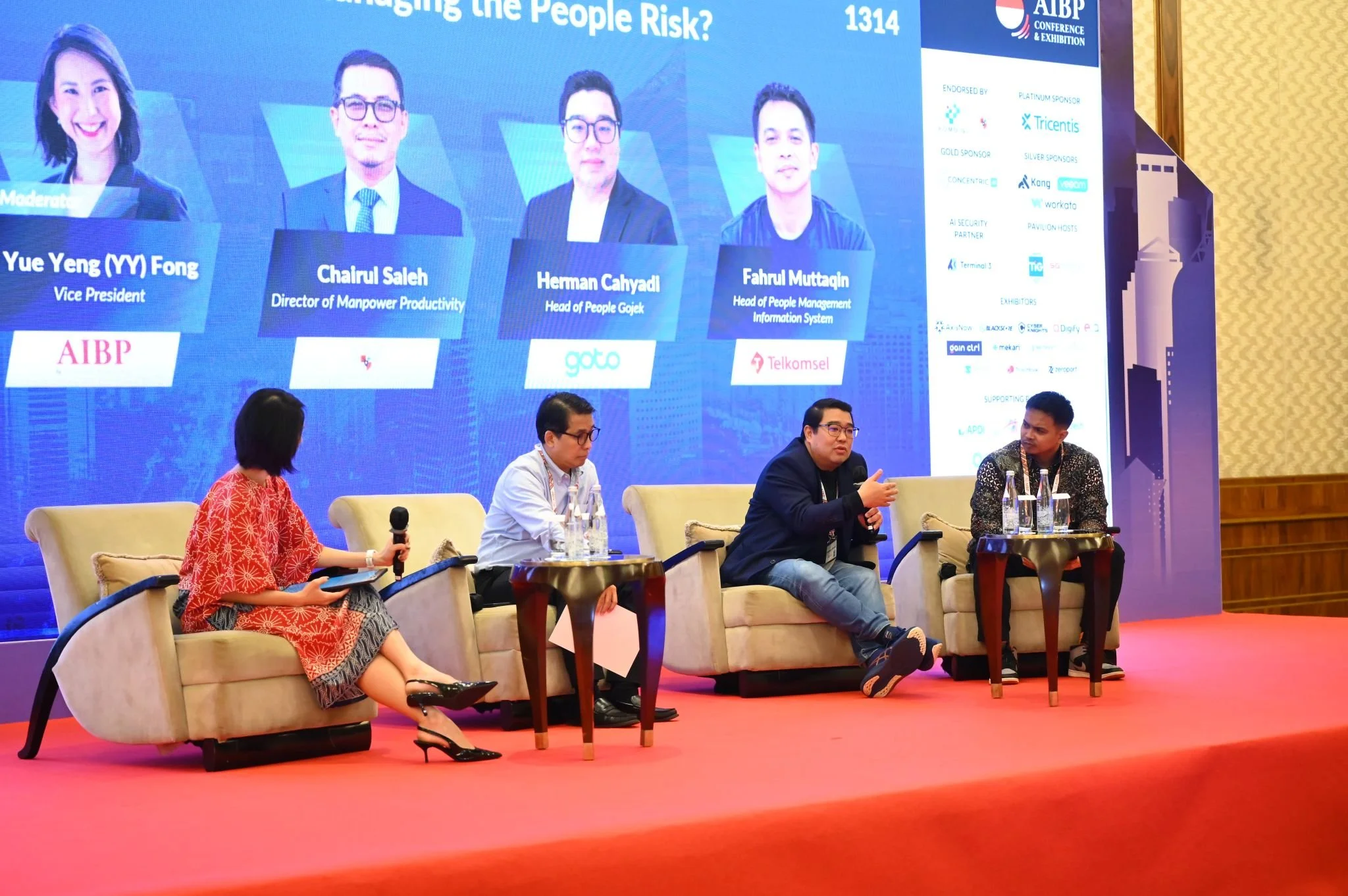
The panel that followed brought the workforce question into sharper focus. Chairul Saleh, Director of Manpower Productivity at the Coordinating Ministry for Economic Affairs, argued that AI should be viewed within Indonesia’s broader economic transformation, with efficiency forming only part of the opportunity. The ambition is for Indonesia to develop the capabilities and ecosystem needed to create AI, making collaboration between government, employers and education critical as the workforce adapts.
Herman Cahyadi, Head of People Gojek at GoTo Group, put the responsibility closer to the organisation. “AI is not a problem. AI is only a tool.” The technology may provide the output, but managers still have to understand what that output means and how it should be used.
He offered his own experience as an example. Analysing an employee engagement survey took him some 48 hours, and 44 of those hours were spent working out what the results meant rather than simply reading what the machine had produced. The point was that interpretation remained a human responsibility.
Fahrul Muttaqin, Head of People Management Information System at Telkomsel, offered a different way of measuring AI’s impact. With two AI functions established across separate directorates, one focused on governance and the other on management, he described how AI is changing where employees begin their work. Instead of starting with a blank page, they increasingly begin with a generated recommendation and spend more time validating, challenging and contextualising it.
Leaders should stop counting licences and use cases launched, he said, and ask what work has changed, which decisions have improved, and whether employees understand their accountability. “Count changed workflows, not only activated licences.”
The Exposure Sits Between the Systems
Before anyone can be expected to supervise an AI system, it has to be built to be supervised. The same question becomes harder in cybersecurity because AI is changing the threat model itself.
Major General Bondan Widiawan, Deputy for Cybersecurity and Cryptography Operations at BSSN, highlighted the growing importance of security by design, least privilege, and zero-trust principles as AI expands the number of systems and interactions that need to be secured.
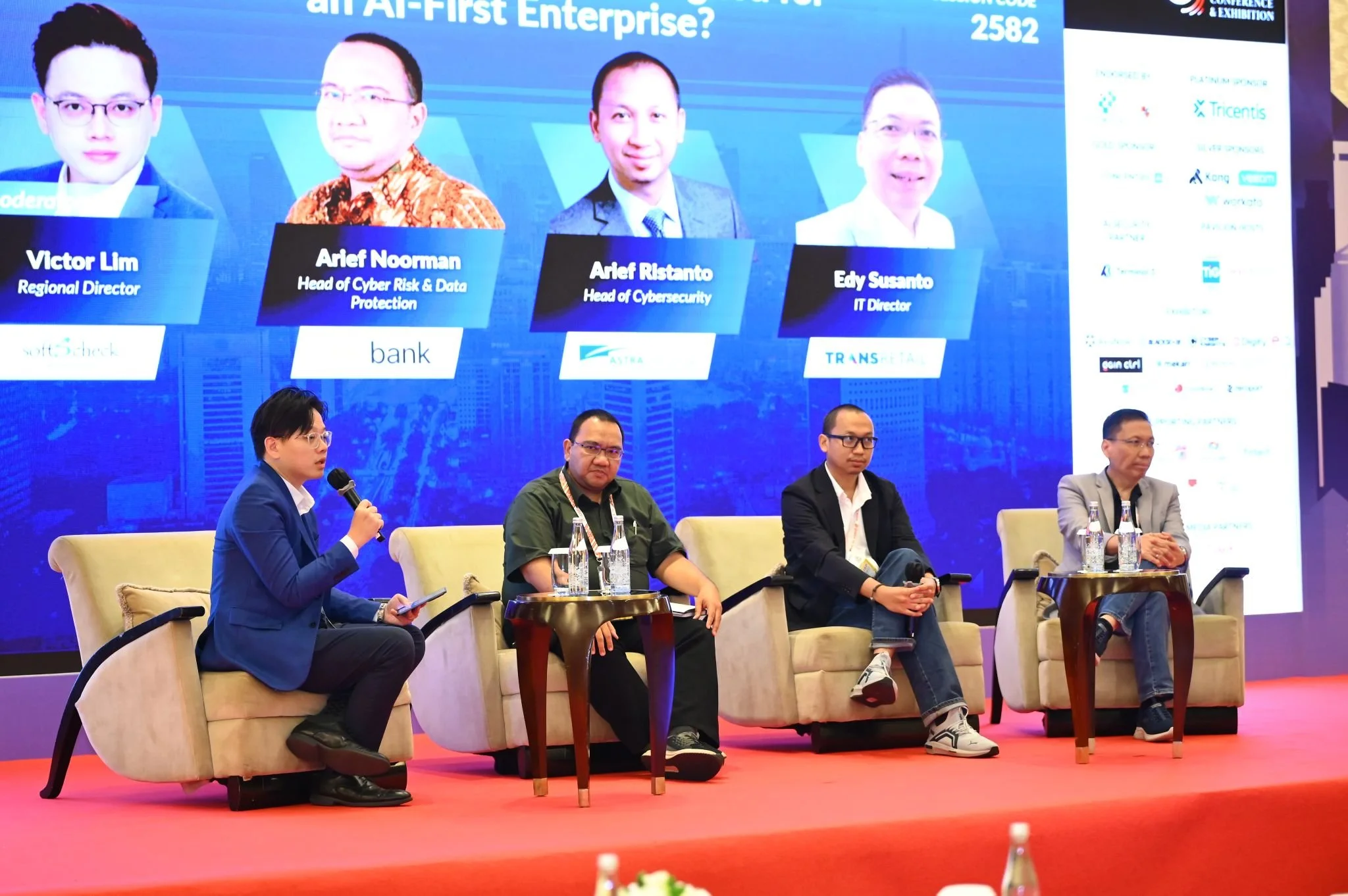
For cybersecurity teams, the question becomes how much of the response can be handed over to automation. Arief Ristanto, Head of Cybersecurity at Astra International, described how Astra has been moving towards greater control over AI use, having led the group’s zero-trust programme and AI governance guideline. The group stopped blocking AI at the office two years ago, recognising that employees could still access these tools through their personal devices. Instead, Astra introduced a governance SOP involving legal, corporate communications, internal audit and risk, supported by continuous awareness campaigns. He said the growing availability of AI is not a reason to automate fully.
That distinction matters because the speed of response has to be balanced against business continuity. Edy Susanto, IT Director at Trans Retail Indonesia, pointed out that a cyber incident does not automatically justify shutting down an entire retail operation. With many stores and point-of-sale systems operating simultaneously, the objective is to isolate the affected environment while keeping the wider business running. He also stressed that governance needs to be matched by awareness, particularly as AI adoption spreads across the organisation. “Governance is good, but if there is no awareness brought to management, that is useless.”
For Allo Bank, the exposure takes several forms. Arief Noorman, Head of Cyber Risk and Data Protection, pointed to deepfakes, liveness fraud and employees exposing sensitive information through public generative AI tools. The challenge therefore extends beyond securing the technology itself to how employees use it and how the organisation manages the resulting risks.
Where the Supervision Actually Belongs
The day’s final discussion moved from AI-assisted work to AI agents making decisions on behalf of the business. Here, the question was no longer simply whether a human should review the output, but where that human should sit in the process.
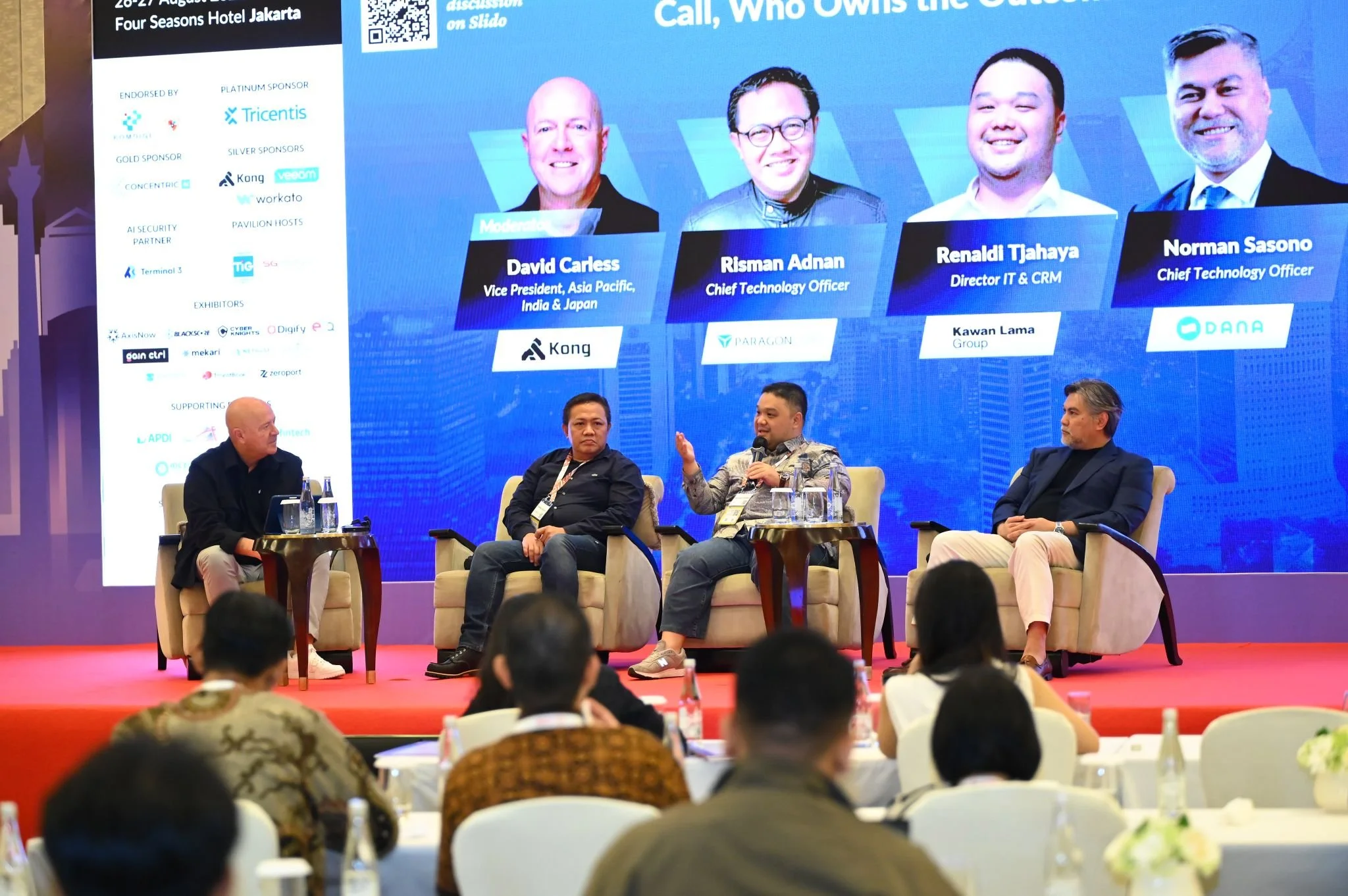
Norman Sasono, Chief Technology Officer of DANA Indonesia, described two approaches based on the nature and volume of the decisions involved. Irreversible, high-stakes and regulatory decisions remain human-in-the-loop, with a person making the final call. For decisions that can occur thousands of times a day, such as content and code generation, requiring human approval for every action is no longer scalable. DANA instead uses a human-on-the-loop approach, allowing AI to act within defined boundaries while people monitor its behaviour and step in when an issue needs escalation.
That distinction also changes what oversight looks like. In a human-on-the-loop model, people are not approving every action. The system needs observability, monitoring, escalation, and kill switches so that a human can intervene when the AI cannot make a decision or begins to behave unexpectedly. At DANA, that ownership is made explicit by assigning one named human as the accountable person for each AI use case. Norman stressed that human accountability remains in place even when AI is making the decision.
A name only means something if the person holding it can judge the work. Risman Adnan, Chief Technology Officer of ParagonCorp, said AI and people need to complement each other. AI can handle complex tasks such as stock allocation across a distribution network, but the person evaluating its output still needs the expertise to judge whether it makes sense. If the agent lacks the knowledge or guidance to get it right, the responsibility sits with the people using it.
Renaldi Tjahaya, Director IT and CRM at Kawan Lama Group, described how this becomes visible in practice. Adoption initially grew organically before governance was formalised. As the organisation moved from experimentation to organisational use, more effort went into the harness around the AI than the model itself. That includes the controls, evaluation, and processes needed to determine when the system can proceed and when a person needs to intervene.
Where the Two Days Come Together
Across the two days, the conversation moved from where AI can create value to what happens when AI starts taking on more of the work and decision-making. Day 1 focused on the business case, data ownership, and how organisations decide where AI should have authority. Day 2 brought those questions closer to the realities of adoption, as AI becomes part of how people work, how organisations manage risk and how decisions are made.
Taken together, the discussions suggest that the harder part of scaling AI is not simply getting the technology to work. It is making sure the organisation is ready for the changes that follow, and prepared to take responsibility for them.
As AI takes on more responsibility, organisations still have to decide how far to let it act, where people need to remain involved and who stands behind the outcome.
Those questions travel on across the region, with AIBP in Manila on 23 and 24 September, where enterprises across the Philippines take up AI ownership and governance, cyber resilience and the economics of scaling agents.
About ASEAN Innovation Business Platform (AIBP)
The ASEAN Innovation Business Platform (AIBP) is an initiative focused on enabling innovation and strategic partnerships across public and private organisations in Southeast Asia. Through curated engagement activities, AIBP supports the growth of regional government agencies, enterprises and solution providers in navigating key themes such as innovation, digital transformation, and sustainability.
Learn more at www.aibp.sg
