
The 50% Nobody Talks About: Why Thailand's Banks Are Winning at AI Commitment and Losing at AI Deployment
TLDR:
Testing, not building, is the binding constraint. It accounts for roughly half of all time from proof of concept to production and cannot be accelerated by adding headcount.
AI governance is being written after the fact. Across Thailand's financial institutions including its most advanced, formal governance documentation is newer than public positioning implies, creating regulatory exposure that is easy to underestimate.
Integration precedes AI, not the other way around. Bank Mandiri's MSME platform and KBTG's data consolidation programme both required three or more years of infrastructure work before meaningful AI deployment became possible.
Token cost visibility is the next board level pressure point. According to AIBP's Innovation Survey 2025/26, 59% of ASEAN enterprises cite unclear AI ROI as a barrier to transformation, yet most institutions have no instrumentation to track what AI projects actually cost.

92% of Thai enterprises believe meaningful AI investment is now required just to hold their competitive position. Yet in practice, few have scalable systems to show for it.
That was the gap the session kept returning to at our last executive session in Bangkok.
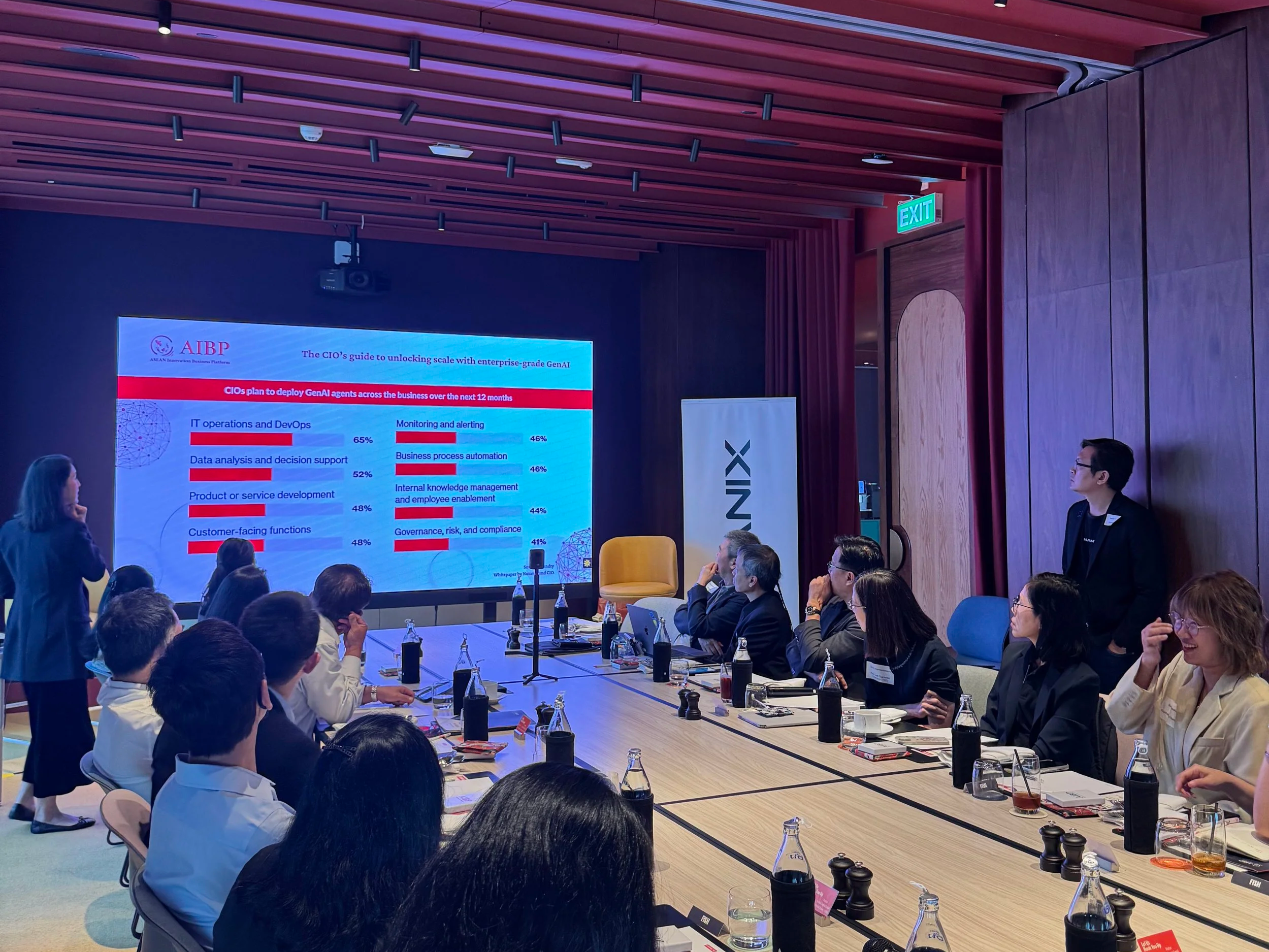
AIBP, together with Nutanix, convened Thailand’s financial services leaders to unpack why AI commitment is not yet translating into real deployment, with discussions centred on testing, governance, data integration, infrastructure readiness, and the cost of scaling AI.
In a closed session bringing together IT and business leaders from Thailand's largest retail banks, state-owned lenders, insurance institutions, and specialist financial bodies, the picture that emerged was not one of momentum. Most have the budgets, mandates and active proof of concept projects. What they lack is a clear path from experimentation to production.
A regional case study from Bank Mandiri Indonesia and a fireside conversation with Kirati Thoednithi, Senior Data Scientist at Kasikorn Labs, sharpened the question the room kept returning to: why AI investment keeps stopping short of production.
Committed Budgets, Stalled Deployment
Across ASEAN, 61% of enterprises have moved beyond identifying an AI strategy to either building a dedicated team or having implemented something, according to AIBP's Innovation Survey 2025/26. The number looks encouraging until you ask what "implemented" means in practice. In Thailand's banking sector, it often refers to successful proof of concepts that worked in controlled environments and generated genuine institutional learning.
The proof of concept phase has built real capability across the sector. Boards are now asking how that investment translates into scalable, usable, and measurable systems.
Across the Bangkok session, teams had spent months proving the quality of their first generative AI projects, reasonable timelines and genuine achievements. Defining the path from that quality to production is where the sector's focus is now turning.
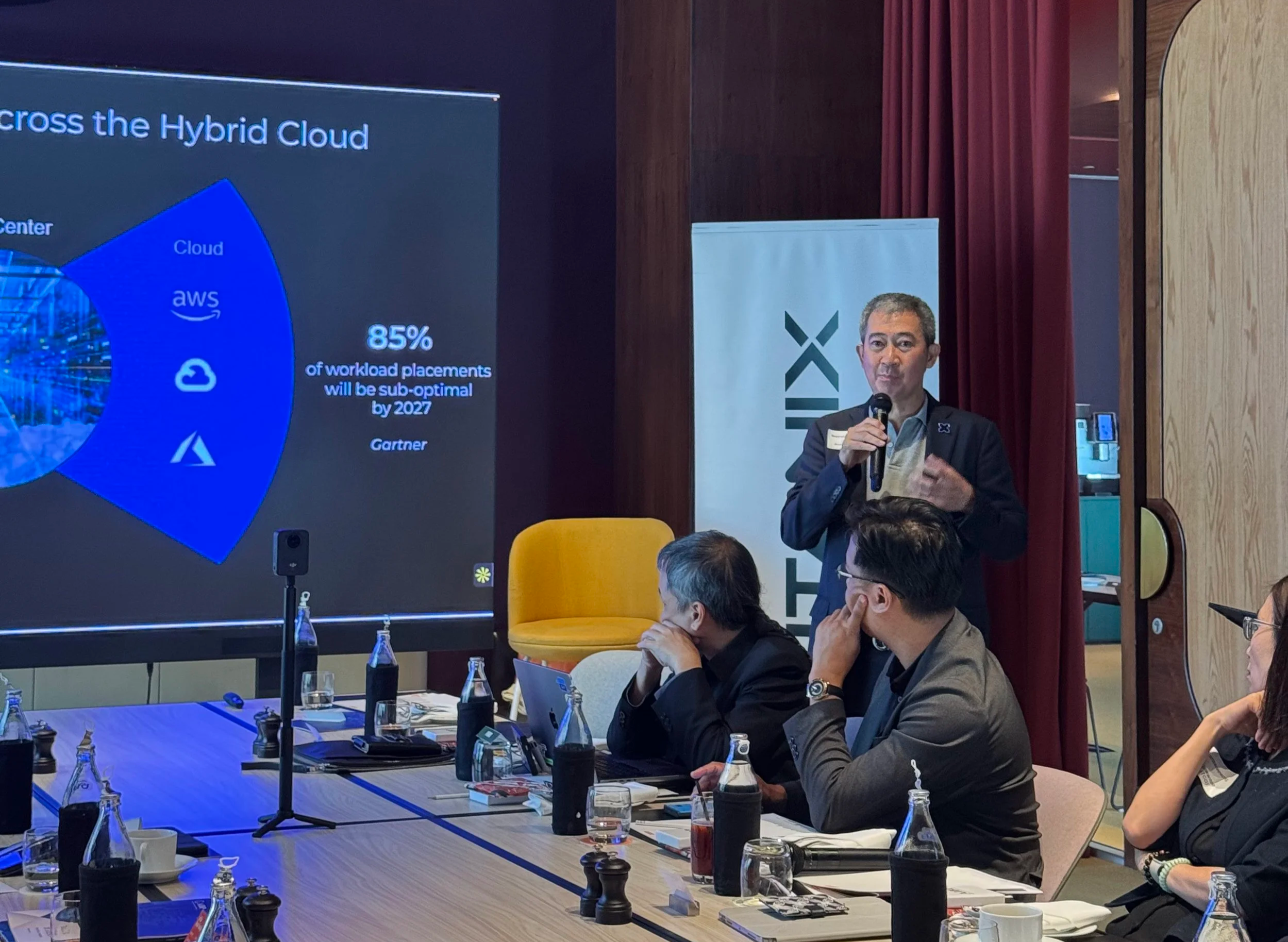
"In the past we talked about the workload, we talked about how fast we can run the application. Right now, most of the IT executives have been asked by the board that the metric has been changed. Now we talk about as-a-service, service level agreement."
— Noppadol Punyatipat, Country Manager, Nutanix Thailand
The Bottleneck That Frameworks Miss

When the enterprise leaders talked about slow AI deployment, they mentioned familiar issues: data quality, legacy infrastructure, governance gaps, and misalignment between business and technology.
"Everyone, IT, business, two from business, we work together as a cross-functional team. When we sit together, we understand each other more, so the data quality improves because we speak the same language. What we get from working together is a solid foundation to pull all the data and break the silos."
— Kirati Thoednithi, Senior Data Scientist, Kasikorn Labs

Building an AI system's foundation accounts for roughly half the total time from proof of concept to production. The other half is testing: formal validation against security requirements, compliance standards, and operational readiness criteria that no regulated financial institution can skip. Unlike building, testing cannot be accelerated by adding engineers. Security reviews, compliance sign-offs, and integration checks operate on institutional and regulatory timelines that sit outside the AI team's control.
KBTG is targeting a reduction from six months to two or three, but the testing timeline remains outside any single team's authority. Data quality compounds this: institutions discover which attributes are unreliable only when someone builds with them, and that discovery cost lands inside the testing phase.
That is why visibility matters before deployment. Teams need to know where data came from, who changed it, when it was modified, and whether it is reliable enough for the model to use.
"If generative AI learns the wrong data, AI will give you the wrong answer as well. Before you deploy your use case to production, you should test it on the sandbox. Your system should have visibility — who put the data, when they put the data, who modified the data."
— Anapat Pipatkitibodee, Senior System Engineer, Nutanix
AI Governance Across Thailand Is Newer Than It Appears

Most institutions at our Bangkok session had established their AI governance structures within the last twelve to eighteen months. Several were still writing the policies that would govern projects already running. This pattern cuts across the full maturity spectrum, including Thailand's most advanced AI organisations.
In many cases, governance committees formed in response to incoming vendor volume rather than strategic intent; risk policies drafted while AI systems are already live; roadmaps developed in parallel with, rather than ahead of, first proof of concept projects. The sequencing reflects the speed at which generative AI became an operational priority, but it has created a regulatory exposure that is easy to underestimate.
Institutions that have run AI projects for two or three years without formal governance risk conflating the absence of visible failure with adequate oversight. With the Bank of Thailand taking a cautious approach to technology and financial sector regulation, institutions will eventually need to show the difference between having governance in practice and having governance properly documented. The window to formalise on the institution's own terms is open, but not indefinitely.
Integration Is the Prerequisite, Not the Preparation

Bank Mandiri's MSME merchant platform, which connected 2.4 million registered merchants across retail, wholesale, and banking channels, served as a regional reference point for the session. Thailand's competitive dynamics, customer loyalty patterns, and regulatory environment are distinct, so the case is most useful for what it reveals about sequencing.
Bank Mandiri's experience showed that shared customer identity and data infrastructure had to come first.
Without it, individual channels had no common foundation on which AI could operate. Kirati arrived at the same conclusion through KBTG's own programme: three years of data consolidation and cross-functional team-building resolved approximately 85% of data silos before meaningful AI scaling became possible. That work was the AI deployment, understood correctly.
AI investment has typically concentrated on the model rather than the infrastructure that makes it deployable and that gap is organisational, not technological.
The Cost Question Boards Will Ask Next
The next major pressure point is cost.
Token economics, meaning the operational cost of running AI models at inference, emerged as a growing concern. As AI usage increases across teams and business functions, institutions will need to understand what each model, workflow, and project actually costs to run.
According to AIBP's Innovation Survey 2025/26, 59% of ASEAN enterprises cite unclear AI ROI as a barrier to transformation, and approximately one third of senior leaders want visibility into AI investment performance within twelve months, a figure rising to 60% within three years. The tools to measure AI spend and output already exist. Most institutions have not yet to put them in place.
Institutions that build cost visibility infrastructure will be better prepared when boards start asking harder questions. This includes tracking token usage by teams and projects, monitoring model costs and creating policies for routing work between cloud and local models.
The Next Phase Is Not Another Pilot
Thailand's banks have the commitment, the mandate, and in most cases the first proof of concept. The next phase requires a different kind of investment. It requires data integration and cross domain alignment before models are scaled. It requires testing as a planned and funded workstream. It requires AI governance that is documented before regulatory pressure intensifies. It also requires cost visibility before usage scales across teams and business functions.
The 92% commitment is clear. For Thailand’s financial institutions, the next phase will depend on how quickly they can strengthen the infrastructure, governance, testing capacity, cost visibility, and organisational alignment required to move AI beyond proof of concept.
About ASEAN Innovation Business Platform (AIBP)
Since its inception in 2012, ASEAN Innovation Business Platform (AIBP) is an initiative focused on enabling innovation and strategic partnerships across public and private organisations in Southeast Asia. Through curated engagement activities, AIBP supports the growth of regional government agencies, enterprises and solution providers in navigating key themes such as innovation, digital transformation, and sustainability.
Learn more at www.aibp.sg
