
Nobody in the Room Rated a Single AI Use Case "Low Impact." That's the Problem.
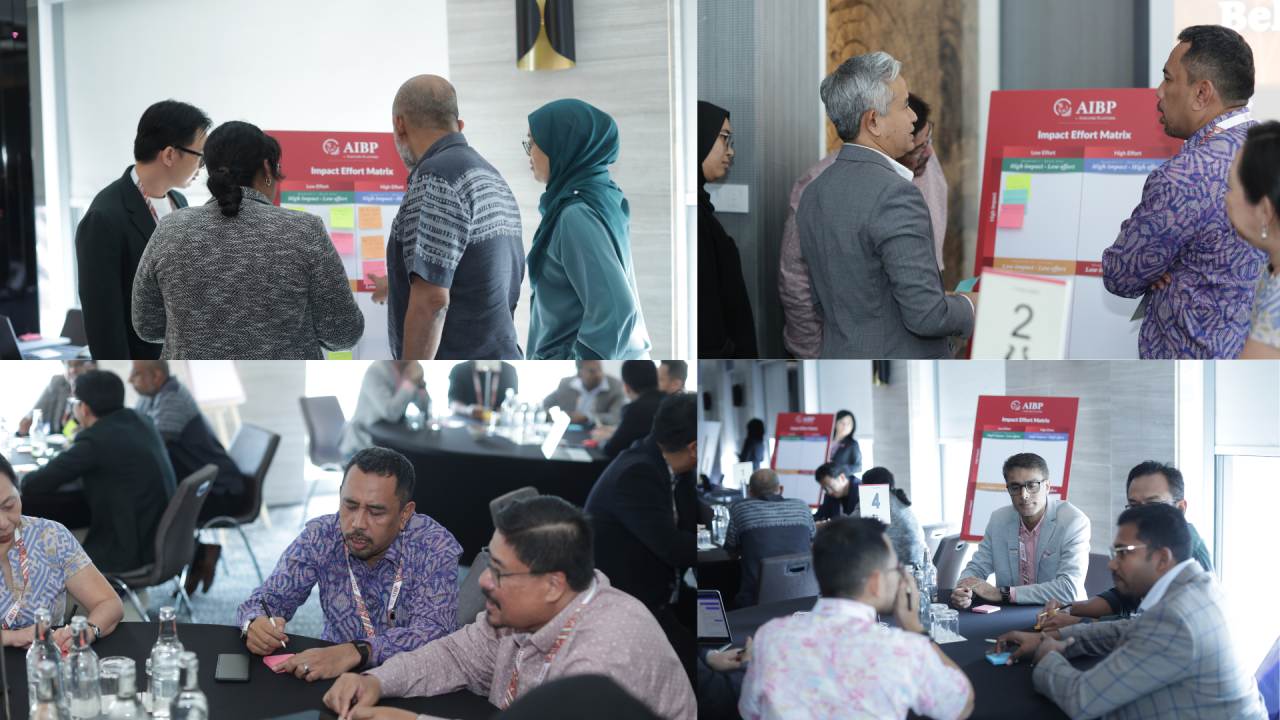
How do you compress ten years of digital transformation scar tissue into two hours? One way is to put one of Malaysia's largest property developers in a room with Johor Corporation's Deputy Chief Digital Officer and Tenaga Nasional Berhad's Data Governance Lead and Digital Strategy Lead, close the door, and give the host's leadership team the opportunity to literally ask anything. The only caveat: time.
That was the gist of AIBP's latest executive workshop, hosted for UEM Sunrise. Just the people currently sequencing their Enterprise AI journey sitting across from the people who have already made the expensive mistakes, at a national utility and one of Malaysia's largest state corporations, and are willing to say so out loud.
If the pairing sounds familiar, it should. TNB opened its own doors to this format at the AIBPxTNB Executive Workshop on Data and AI in Practice, and it sits within a body of work AIBP has been building across Southeast Asia since 2012: hosted working groups, regional enterprise exchanges, internal innovation, digital and culture days, and benchmarking sessions. Different formats, one principle: the fastest way through a transformation problem is a candid conversation with someone who has already been through it.
In an attempt to summarise the two-hour battle, here is where the conversation went.
Round One: 40 Use Cases, Five Minutes, One Matrix
The session opened with a deceptively simple exercise. Teams brainstormed Enterprise AI use cases against the clock, then classified them on an impact-effort matrix: quick wins to do first, big payoffs worth the investment, and the high-effort, low-impact ideas to avoid or outsource.
More than 40 use cases surfaced across the tables. The quick wins clustered around personalised marketing, financial modelling, intelligent process automation, business analyst copilots, and document and data quality control. For UEM Sunrise's real estate business specifically: generative design for land utilisation, AI-assisted recruitment and customer service optimisation all landed in the high-impact, low-effort quadrant.
The big payoffs were more ambitious. An agentic concierge to elevate the customer sales journey, with the effort sitting less in the technology than in brand alignment. Post-occupancy project lifecycle management through digital twins and predictive maintenance. AI procurement. Asset prediction and remaining useful life modelling. Cognitive vision for construction site safety earned a notable caveat: high impact but lower effort than expected, because market solutions already exist.
Two observations cut across every table. Effort is relative: what is a quick win for an organisation with mature data infrastructure is a multi-year programme for one without. And almost nothing was rated low impact. One table declined to put a single idea in the low-impact quadrants at all. That is the title of this piece, and it is the real challenge facing Malaysian enterprises: when everything looks high impact, prioritisation, not ambition, becomes the battleground. The room was past debating whether AI matters; the entire discussion was about sequencing.
What TNB Brought: Data Governance as a Parallel Stream, Not a Prerequisite
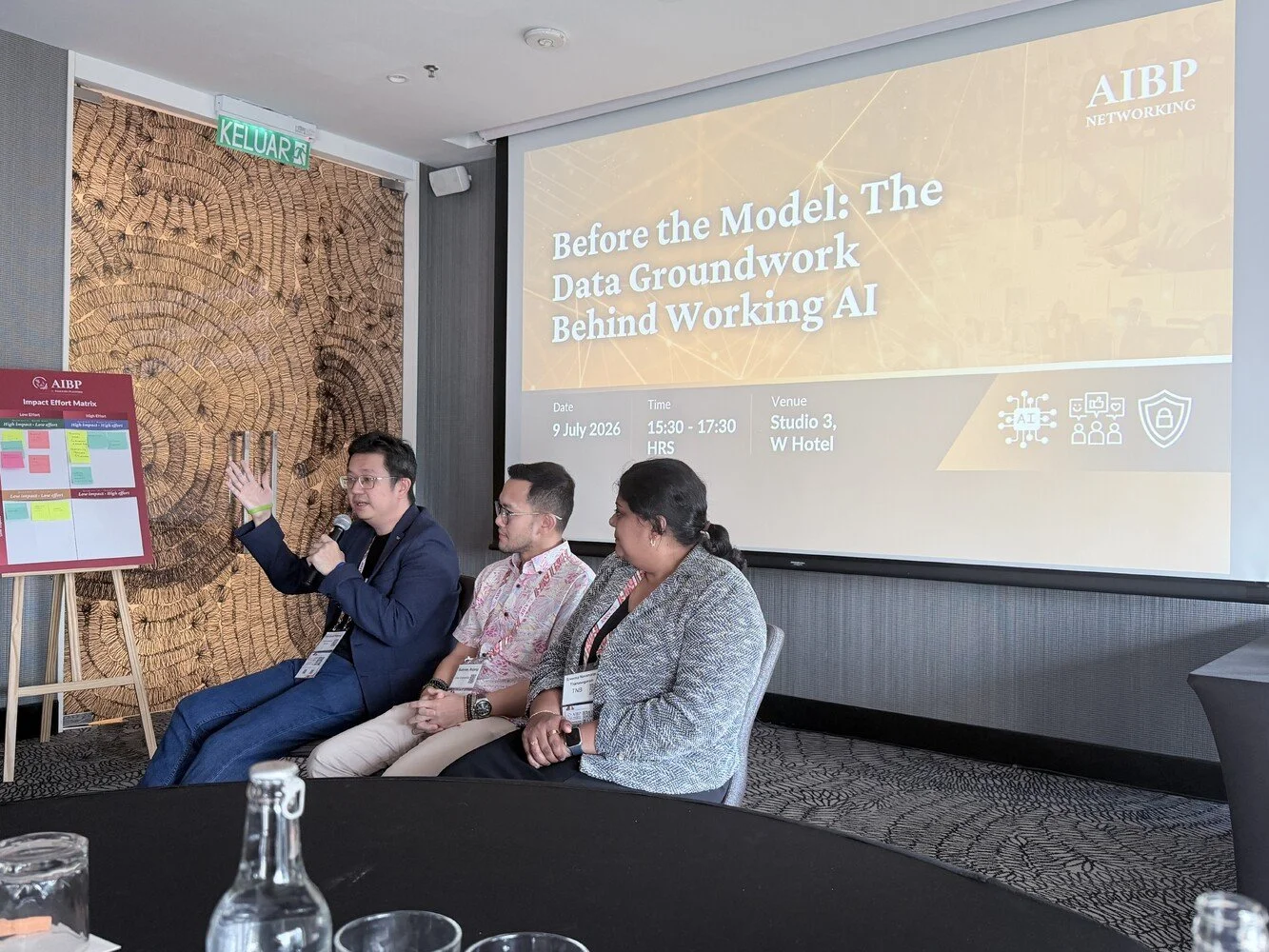
The most quoted idea of the afternoon came from TNB's Enterprise Data Governance practice, a programme the utility has been building since 2020 and shared in depth when it hosted AIBP at its own executive workshop: govern in parallel, not in advance. Rather than freezing AI delivery until enterprise data is perfect, TNB runs data governance as a symbiotic parallel stream alongside AI delivery. Teams prototype with imperfect data to prove value quickly, while governance work improves metadata and data quality in the background. Only when a use case is validated and headed for production does the bar rise: business-critical applications run exclusively on golden data from official master sources.
Paired with this was a small data philosophy: use minimal, high-quality datasets to demonstrate value fast and convince stakeholders, rather than waiting on an enterprise-wide data lake that may never be finished.
On asset strategy, the guidance was equally pragmatic. Before committing to a full digital twin of an entire system such as a substation, start with an asset twin: a digital replica of a single, high-value asset. Prove the model, then scale.
What JCorp Brought: Architecture, a Data Quality Index, and OKRs Over Silos
JCorp's Deputy Chief Digital Officer made the case that most digital transformation failures stem from a disconnect with business value, and that the antidote is enterprise architecture. JCorp's blueprint-driven digital strategy ensures every AI initiative is tied to a clearly defined business problem, supported by an in-house EA platform that links financial, governance and risk systems for holistic visibility.
Managing varied digital maturity across a diverse group of subsidiaries, a challenge any Malaysian conglomerate or GLC will recognise, JCorp applies a Data Quality Index with associated confidence levels, monitored by AI agents. Performance is tracked through shared OKRs rather than siloed KPIs, deliberately pushing subsidiaries toward ecosystem-level thinking. On the supply side, the ambition is a single pane of glass across vendors, consolidating purchasing to reduce cost and manage risk.
New initiatives pass through a formal Digital and AI Registry, evaluated on three criteria: business value and alignment with organisational objectives, data availability as the critical prerequisite, and workflow impact. Where multiple use cases overlap, JCorp consolidates them into unified platforms rather than accumulating point solutions.
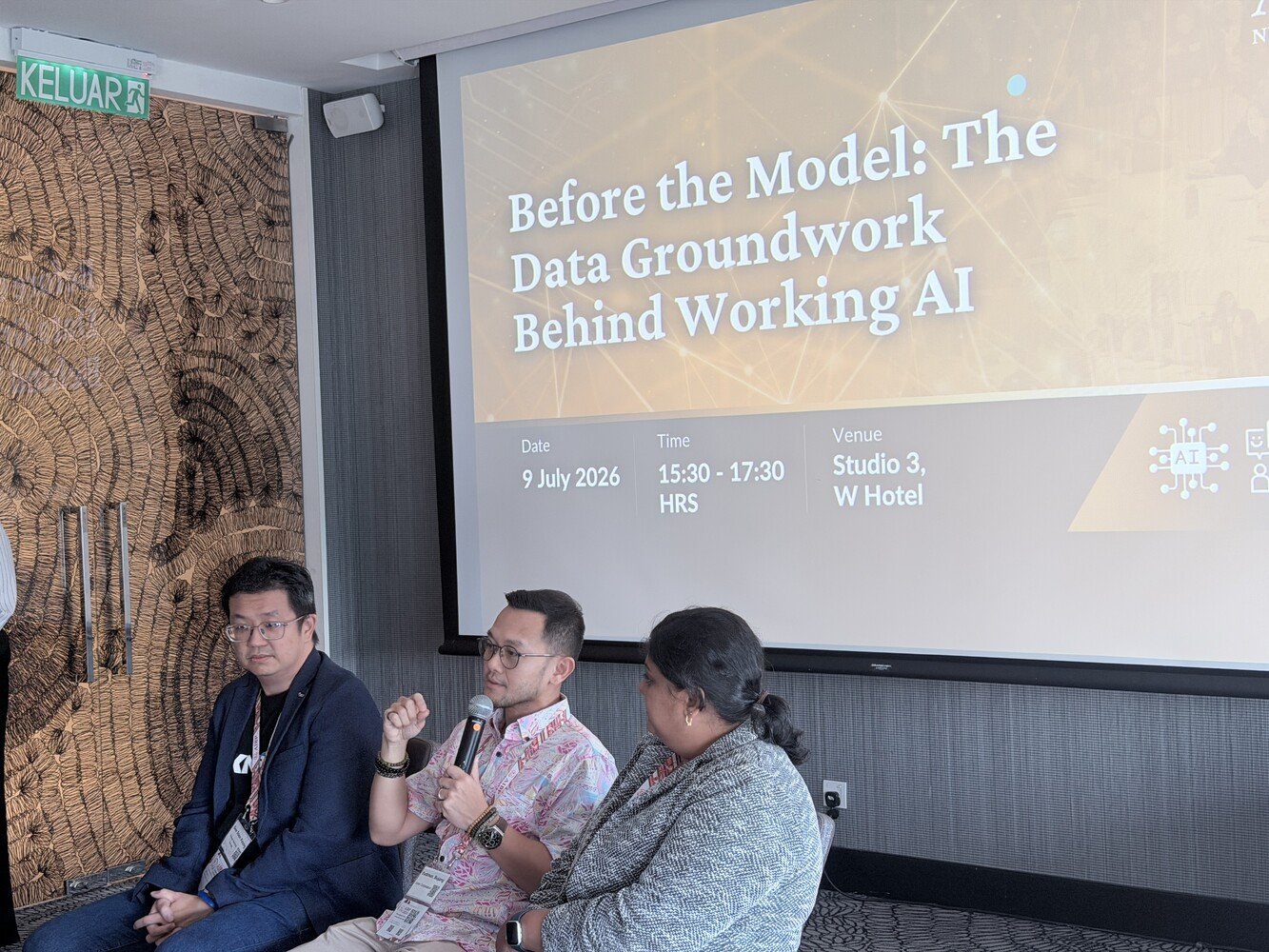
The Questions That Would Not Stay Polite: Security and Accountability
No AI is secure out of the box, and the room did not pretend otherwise. Organisations remain legally responsible for their AI's outputs, a point driven home by the court ruling against a car dealership whose chatbot made an unauthorised offer. Even frontier models can be manipulated, creating business risks that range from reputational (harmful outputs) to material (model and IP theft).
The threat picture sharpened the urgency, echoing what security leaders told AIBP in earlier discussions on proactive cyber risk management and resilience. Attack volumes have surged because attackers themselves now use AI, shifting the fight from human versus human to AI versus AI, and cybercriminals are increasingly targeting medical and healthcare data over financial data. The preparedness list was concrete: more frequent patching cycles, more zero-day vulnerabilities, heightened supply chain risk, and exposure from legacy equipment. The conclusion was unanimous: fight AI with AI, because human teams alone cannot keep pace.
The Hardest Question: People
Perhaps the most honest stretch of the two hours concerned adoption. An AI MVP can be built in weeks; getting an organisation to use it is the long war. The drivers of adoption, the panel agreed, have nothing to do with age and everything to do with a passionate, open mindset. It is the same conclusion PETRONAS reached when it worked with AIBP to put culture, not technology, at the centre of its Culture Agent Meet dialogue on humanising innovation: people lead the transformation, or the transformation fails.
The tactics shared were refreshingly unvarnished: publish adoption visibly through an internal AI Power Index, automate escalations so leadership sees exactly where adoption stalls, apply a direct top-down mandate where needed, and concentrate early wins on the most enthusiastic business units so they champion change for everyone else. Accountability, the panel noted, requires enforcement with clear repercussions, not encouragement alone.
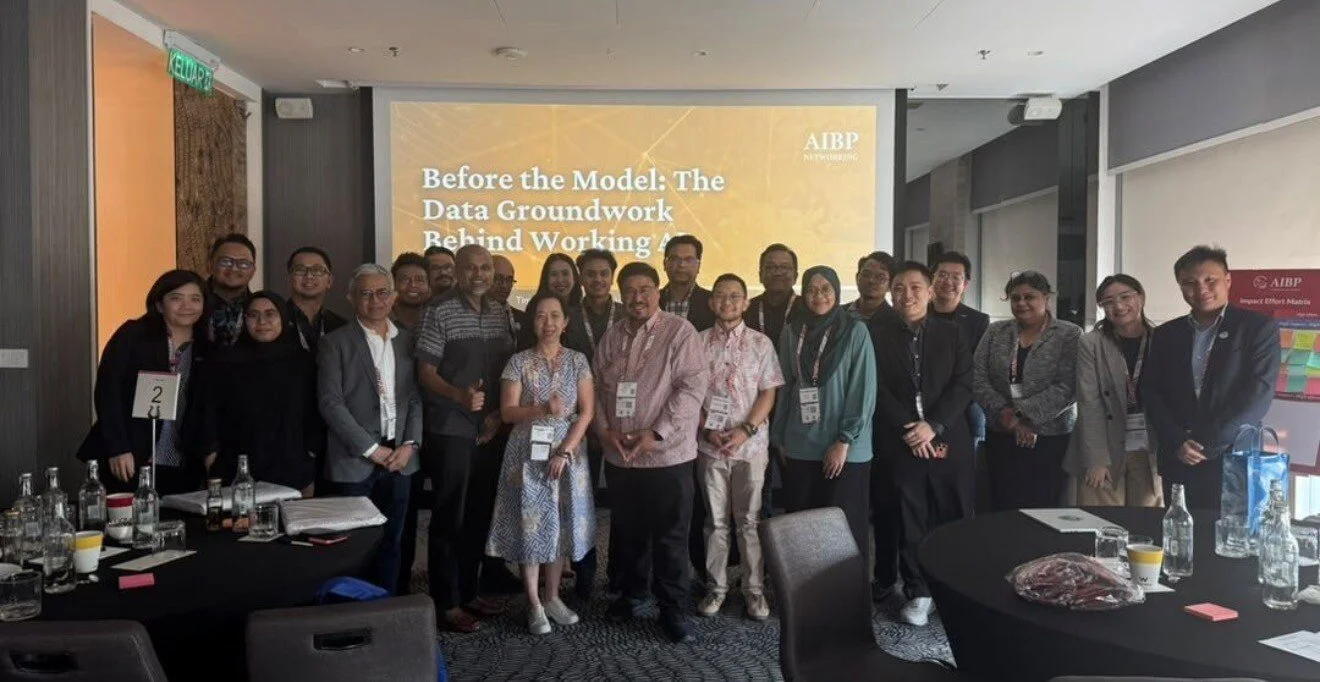
That is the AIBP model in miniature, and it is a well-worn path. The same convening has taken PETRONAS and PERTAMINA across the causeway and back to shape the future of national energy, put culture on the agenda at PETRONAS, and brought TNB's data and AI practice into open conversation with its peers. Whether through hosted working groups, regional enterprise exchanges across ASEAN, internal innovation and culture days, or benchmarking sessions against a network of more than 30,000 stakeholders, the value is the same: access to peers who have done it, assessment against those who are doing it, and advocacy for what Southeast Asian enterprises need next.
Organisations interested in hosting an AIBP executive workshop, working group or exchange in Malaysia can reach out to the AIBP team.