
AI That Pays Off: Inside Malaysia’s Enterprise Playbook
TLDR;
AI maturity varies across organisations. This uneven maturity complicates ROI measurement and requires differentiated evaluation approaches.
Alignment and governance matter: Effective AI deployment depends on organisational coherence. Structures, data foundations, decision frameworks, and application landscapes must align to deliver outcomes.
Beyond pilots: Measuring ROI requires assessing impact across the entire value chain, prioritising initiatives, and enforcing investment discipline. Outcome-based models and clear frameworks help organisations focus on high-value projects.
Data is foundational: Enterprises must address silos, rationalise legacy systems, and implement robust data infrastructure to enable accurate insights and measurable returns.
People and processes are critical: Technology alone does not generate ROI. Teams must understand workflows, access patterns, and integration points, with investment planning aligned to how data and tools are actually used.
Redefining ROI: Leading organisations take a holistic view, combining short-term wins with long-term strategic impact in innovation, resilience, and sustainable growth.
Across Southeast Asia, enterprise investment in AI continues to rise, but spending alone does not guarantee value. 81.3% of organisations plan to increase AI investment, largely driven by competitive pressure. Yet AI initiatives are often rolled out faster than the organisational structures, data foundations and decision frameworks required to support them at scale. When these elements are misaligned, returns become fragmented, difficult to measure, and harder to justify as investment grows.
There is a parallel risk at the other extreme. Organisations that struggle to articulate returns may slow or abandon AI initiatives altogether, forfeiting longer-term gains that often take years to materialise. ROI, in this context, serves as a strategic compass, anchoring AI initiatives to business outcomes and helping leaders distinguish signal from noise.
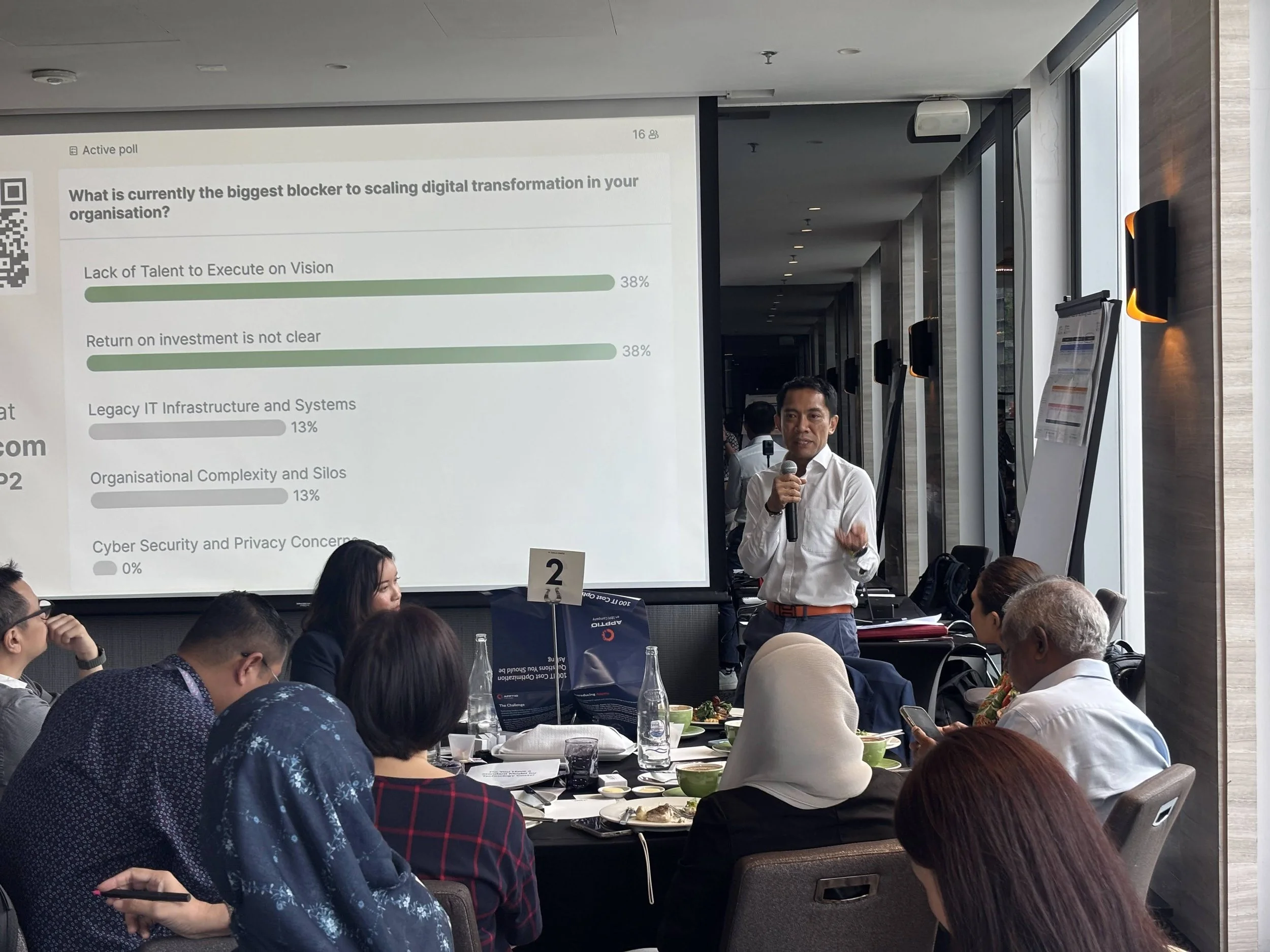
Against this backdrop, AIBP, together with Apptio and MongoDB, convened a private discussion in Kuala Lumpur, bringing together Malaysian enterprises to how leading enterprises balance priorities, align teams, and decide when to build, buy, or integrate AI solutions effectively.

AI Maturity Is Not Uniform: Mind the Gap
The returns from AI rarely arrive on a predictable timetable. In many cases, meaningful impact can take several years to emerge. Most large organisations therefore operate across multiple levels of AI maturity simultaneously with proven, revenue-generating use cases running alongside newer, exploratory initiatives still searching for traction.
In banking, for instance, AI is already well established in domains such as fraud detection, treasury, and trade finance, where value is proven and broadly accepted. At the same time, newer applications are still in early stages of experimentation, with benefits that may only emerge over time. Applying a single ROI lens across initiatives at such different maturity levels can lead to distorted expectations and premature judgments about performance.
According to Meraj Khan, Executive Vice President of Strategy, Architecture & IT Foundation at Maybank, organisational complexity further sharpens this challenge. Large regional banks operate across multiple country units, product lines, and functional domains, each governed by distinct priorities, regulatory environments, and performance metrics. Aligning these layers to deliver enterprise-wide AI value is less a one-off initiative than an ongoing managerial task.
That complexity extends to the application landscape itself. Even with disciplined governance, ensuring resources are directed toward systems that deliver outcomes — rather than perpetuating legacy cost structures — requires continuous attention as technologies and business needs evolve.
To manage this tension, Khan’s team adopts a two-tiered measurement approach. “Above-the-line” metrics capture hard business outcomes such as revenue growth, cost efficiency, and profitability. “Below-the-line” indicators track earlier signals — including platform adoption, model development velocity, data readiness, and user engagement. Together, they allow the organisation to balance patience with accountability, recognising that financial returns often lag the foundational work that enables them.

Defining ROI Beyond Pilots
If AI ROI is to be credible, it must extend beyond pilots and isolated efficiency gains. Returns need to be assessed across the entire value chain, underpinned by clear thresholds for prioritisation and disciplined investment decisions.
At Petronas Digital, the digital arm of Malaysia’s national oil company PETRONAS, this discipline is built directly into how technology decisions are made. A consistent value framework is applied across all business lines, with finance sign-off ensuring transparency, comparability, and accountability at scale. The aim is not to constrain innovation, but to ensure scarce resources are deployed where they can deliver demonstrable impact.
“Any AI or deep learning solution must clearly demonstrate how it will generate additional cash or reduce costs.”, shared Encik Shaharuddin Hamid, CEO at Petronas Digital.
This value framework also helps balance demand from business units with delivery capacity from digital teams. In recent years, Petronas Digital has evolved its operating model to prioritise outcomes over effort. Rather than relying solely on internal manpower, teams increasingly engage outcome-based partners, who bid on projects, products, or services based on delivered results rather than hours worked or headcount deployed. This shift reinforces accountability while accelerating time to value.
Once priorities are set, attention turns to identifying which data matters most. This perspective aligns with insights from Jitra Phunpairoj, Brand Sales Specialist at Apptio, who stresses the importance of starting with clarity on business objectives.
“You need to be clear about your main priorities. Do you want to cut costs, or gain full visibility of your IT spend? Start with what matters most, then decide which data initiatives to pursue. From there, you can map it to a taxonomy like Technology Business Management (TBM) to identify where full visibility is possible and optimise your IT costs effectively,” Jitra shared.
By combining a priority-driven approach with a value-based framework, organisations can focus investments where they truly matter, ensuring AI and digital projects deliver measurable ROI.
The Data Side of ROI
If AI is the engine, data is the fuel, and in large enterprises, that fuel is rarely clean or easy to access. Jackie Cheong, Chief Data Officer at Aeon Credit Services, argues that building an AI-ready organisation begins with understanding where data resides and how it flows across the enterprise.
“Before you even think about AI, you need to understand your sources, your middle layers, and how data moves across the organisation. Only then can you define a meaningful AI journey.”
Technology, however, is only part of the challenge. In regulated industries such as financial services, legacy systems, compliance requirements, and departmental silos create persistent friction. Hundreds of applications may coexist, each operating in isolation. Until this complexity is addressed, AI ROI remains theoretical.
From a strategic perspective, the objective is data democratisation: making information accessible across departments while maintaining governance and control. Only when data is structured, trusted, and available can AI initiatives consistently translate into business outcomes.
Paul Cleenewerck, Enterprise Solutions Architect at MongoDB, reinforces this point. Expecting AI or large language models to deliver unified insights without addressing underlying data silos is a common and costly miscalculation.
He outlines two distinct consolidation paths. Internal AI use cases can rely on data lakehouses, where latency is less critical and centralised data supports experimentation and insight generation. External-facing applications, by contrast, demand real-time integration across legacy systems, often requiring middleware to stream live data into AI layers.
“Without proper planning, budgets and ROI expectations rarely align. Getting the data right is the foundation for any successful AI investment.”, Paul says.
Breaking Silos, Building Coherence
Technology alone won’t deliver ROI; people, processes, and clear objectives matter just as much.
Every enterprise operates with its own objectives, constraints, and maturity levels. The challenge is to articulate a digital vision and translate it into a roadmap that reflects organisational reality, not aspiration.
For Dr. Ambrose Gerard Corray, Vice President of Infotech and Digitalisation at Hibiscus Petroleum, the priority lies in ensuring data reaches the right people, at the right time, with minimal friction. That requires not just systems, but codified pathways that make access intuitive and repeatable.
Data, he argues, is corporate currency. When knowledge is scattered across systems, staff turnover risks creating “corporate amnesia.” Hibiscus addressed this through a major rationalisation effort — reducing millions of files to a curated set of critical records, classified under a consistent taxonomy.
The discipline extends to workforce capability and investment planning. Projects are phased over time, costs assessed holistically, and workloads deliberately distributed across on-premises and cloud environments. The objective is not cost minimisation, but alignment — ensuring spending reflects how data is actually accessed and used.
“Many organisations think vertically or horizontally. But a holistic view is essential. You must understand workflows, access patterns, and integration points before making investment decisions. That’s where real value is created.”, Dr Ambrose shares.
Hard Numbers, Harder Questions
AI is forcing organisations to reconsider what value truly means. Traditional ROI models often struggle to capture benefits that accrue gradually or manifest outside conventional financial metrics.
The experience of Malaysian enterprises suggests that AI ROI is constrained less by technology than by organisational coherence. Where data foundations are fragmented, priorities misaligned, and decision rights unclear, returns remain elusive. Where discipline is applied across data, people, and process, AI investments begin to compound.
The organisations seeing progress are those building mature ecosystems: integrating platforms, reskilling teams, scaling infrastructure, and strengthening governance. They balance short-term wins with long-term ambition, evaluating ROI not only through cost savings, but as a measure of resilience, adaptability, and sustainable growth.
In the end, AI value is organised.
—————————————-
About ASEAN Innovation Business Platform (AIBP)
Since its inception in 2012, ASEAN Innovation Business Platform (AIBP) is an initiative focused on enabling innovation and strategic partnerships across public and private organisations in Southeast Asia. Through curated engagement activities, AIBP supports the growth of regional government agencies, enterprises and solution providers in navigating key themes such as innovation, digital transformation, and sustainability.
Learn more at www.aibp.sg
